When to Use ColorVu, Infrared & LPR in Sarawak
Both are easy to sell. Both waste money if the scene is wrong.
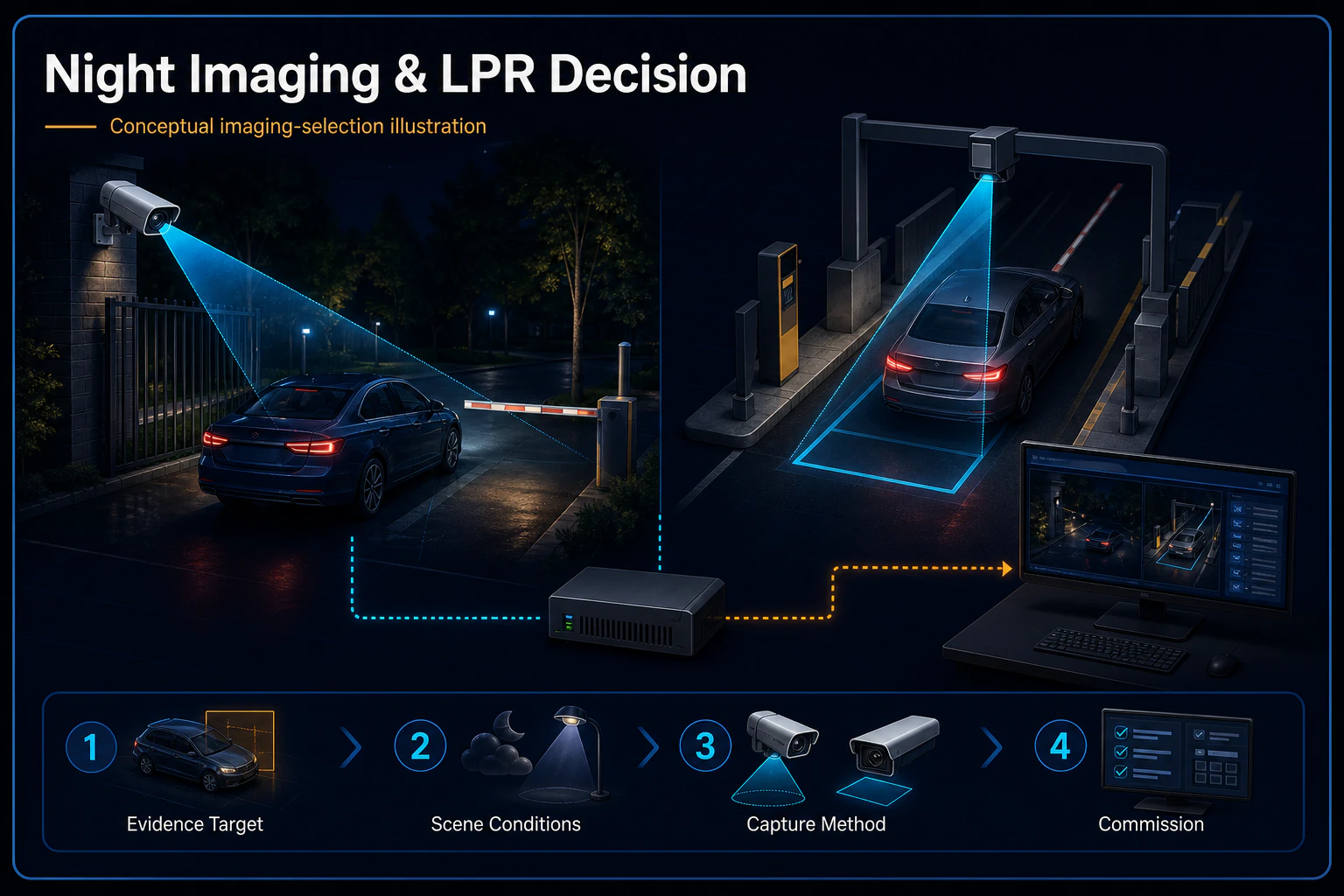
- 01Evidence target
- 02Scene & lighting
- 03Capture choice
- 04Commissioning
Last reviewed: 23 August 2026 · HJ Security engineering guide
ColorVu, IR and Smart Hybrid Light solve different night scenes
Use full-colour night imaging when colour is an evidence requirement and the mounting position, ambient light and permitted supplemental light support it. Conventional IR may be the better choice where discreet black-and-white night coverage is enough. Smart Hybrid Light adds selectable IR, white-light and event-responsive lighting modes on compatible cameras; it does not automatically mean that every model includes two-way audio, a siren or active deterrence.
Start with the evidence target, not the camera label
Record the target first: a face at a doorway, clothing colour in a lane, a vehicle at a controlled entrance, or general movement around a compound. HJ then checks target distance, lens angle, backlight, glare, rain exposure and the effect of white light on neighbours or drivers. If the existing porch lighting already supplies usable colour, a second view or more storage may add more value than changing every camera.
Use LPR only when the vehicle approach is controllable
LPR or ANPR works best when the plate crosses a defined capture zone at a suitable angle, distance and speed with controlled lighting. A whitelist can then support authorised barrier access. Mixed motorcycles and cars, tight turns, dirty plates, headlight glare, heavy rain or a camera mounted only for general overview can reduce useful reads. In those conditions a UHF, card, QR or attended process may be more reliable.
Detection, recognition and barrier control are separate functions
Person/vehicle classification can reduce irrelevant motion events, but it is not facial recognition. A general CCTV camera seeing a car is not automatically an LPR camera. Reading a plate does not by itself make a safe barrier lane: loop detectors, radar or safety sensors, lane logic and a manual fallback still have to be designed and tested.
Official product reference and HJ's role
Hikvision's official ColorVu Smart Hybrid Light explanation describes IR, full-colour and Smart Mode behaviour. HJ uses manufacturer information to confirm model capability, then validates the scene, integration and commissioning on site. Product model, stock and supply remain with the linked ISD catalogue.